
How this page is organised
This page explains how I work as a counselling psychologist. It begins by outlining the approach that guides my practice, followed by a closer look at the core frameworks that inform it. The aim is to offer you a clear sense of how your difficulties may be understood and how our work might develop over time.
How this page is organised
This page explains how I work as a counselling psychologist. It begins by describing the approach that guides my practice, followed by a closer look at the core frameworks that inform it. The aim is to offer you a clear sense of how your difficulties may be understood and how our work might develop over time.


My approach to therapy
When you read about a therapist’s approach, you’re learning which models of therapy shape how they understand you and how they decide what to focus on in your work toegether.
I work in an integrative way, meaning I do not limit us to a single therapeutic model. Instead, the work is shaped around you and the particular difficulty you are facing, drawing on different ways of working where these are genuinely helpful and appropriate.
In my work, the use of integration is guided by formulation — a shared way of making sense of what is happening for you, how it may have developed, and what continues to keep it going. This shared understanding determines the focus of the work and the methods that are used, rather than techniques being applied in advance.

My approach to
therapy
When you read about a therapist’s approach, you’re learning which models of therapy shape how they understand you and how they decide what to focus on in your work together.
I work in an integrative way, meaning I do not limit us to a single therapeutic model. Instead, the work is shaped around you and the particular difficulty you are facing, drawing on different ways of working where these are genuinely helpful and appropriate.
In my work, the use of integration is guided by formulation — a shared way of making sense of what is happening for you, how it may have developed, and what continues to keep it going. This shared understanding determines the focus of the work and the methods that are used, rather than techniques being applied in advance.


The frameworks behind my approach
Our shared understanding is anchored in two established psychological frameworks: CBT and psychodynamic thinking. These form the main foundations of how I think about difficulties and how we develop our work together.
They are not alternatives to choose between. Each offers us a different perspective on the same difficulty, drawing attention to aspects that the other may not fully capture on its own.
The sections below set out what CBT and psychodynamic thinking each contribute, and how they are used within an integrative way of working when deciding how to respond to what you are facing.


The frameworks that inform my approach
Our shared understanding is anchored in two established psychological frameworks: CBT and psychodynamic thinking. These form the main foundations of how I think about difficulties and how we develop our work together.
They are not alternatives to choose between. Each offers us a different perspective on the same difficulty, drawing attention to aspects that the other may not fully capture on its own.
The sections below set out what CBT and psychodynamic thinking each contribute, and how they are used within an integrative way of working when deciding how to respond to what you are facing.

CBT as a core framework
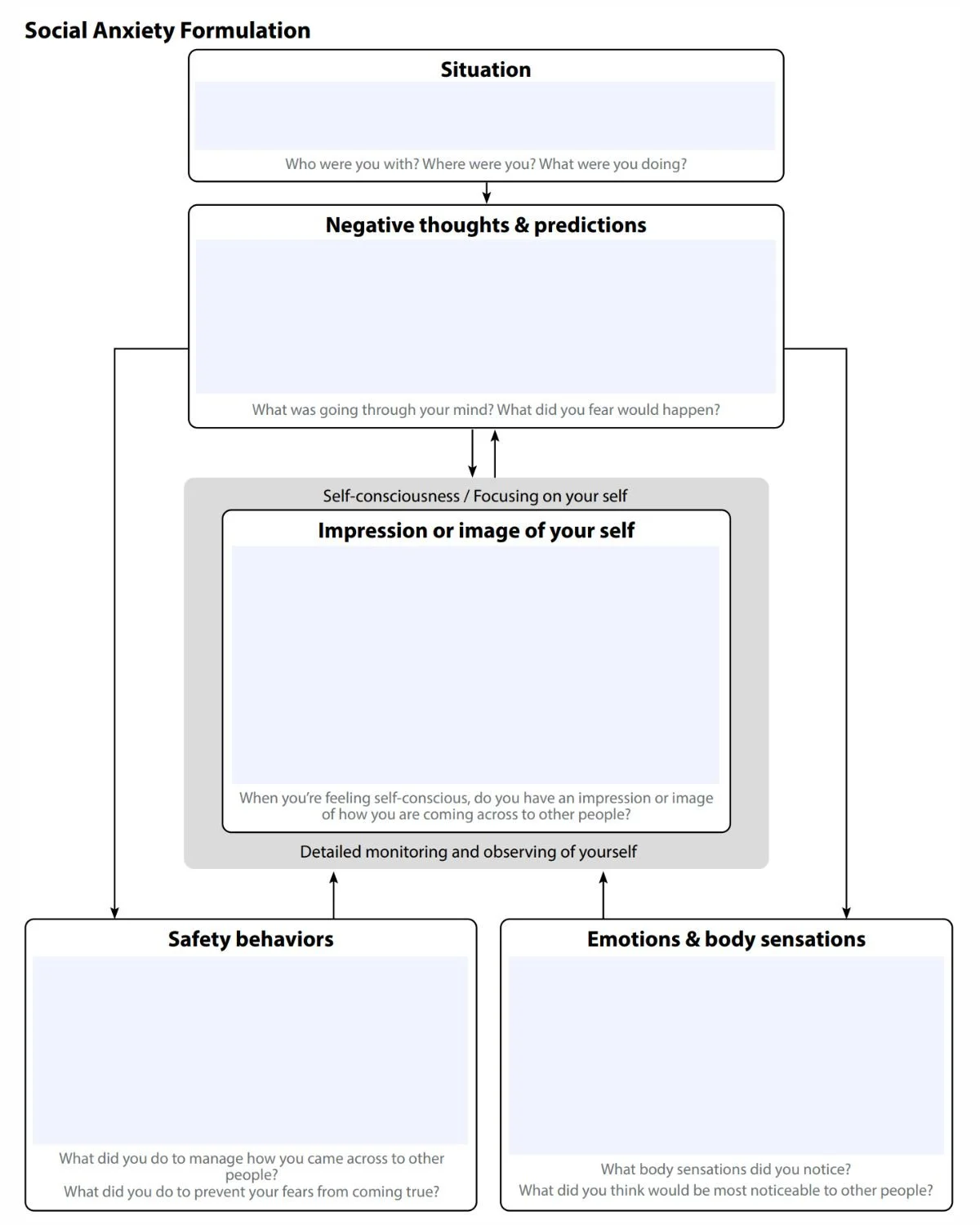
CBT provides a clear, structured way of understanding what is happening in the present. It focuses on patterns between thoughts, emotions, behaviour, and bodily responses, and how these can interact to keep difficulties going.
In my work, CBT helps us map out what is maintaining the problem now. This might include habitual ways of thinking, avoidance patterns, safety behaviours, or responses that once made sense but have become restrictive over time. Making these patterns visible allows the work to become more focused and intentional. An example of this kind of mapping is shown right, illustrating how different elements of a difficulty can interact to keep it going.
CBT also offers practical ways of responding differently, where change is needed. This can involve testing assumptions, experimenting with new behaviours, or developing specific skills. Any such work is guided by the shared understanding we develop, rather than applied as a set of techniques.
Within an integrative approach, CBT contributes clarity, structure, and a present-focused lens. It is often combined with other ways of working where this helps deepen understanding or support longer-term change.

CBT as a core
framework
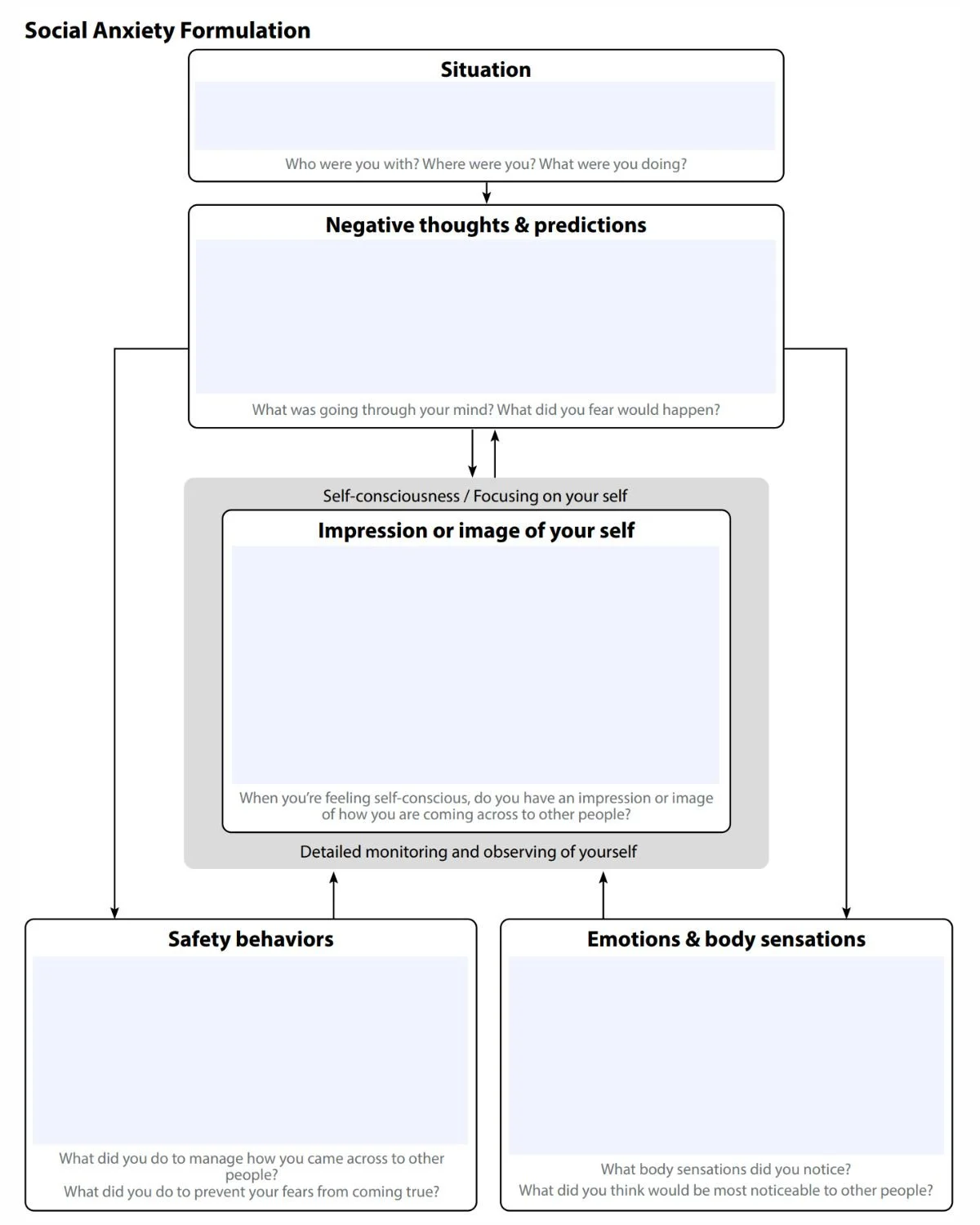
CBT provides a clear, structured way of understanding what is happening in the present. It focuses on patterns between thoughts, emotions, behaviour, and bodily responses, and how these can interact to keep difficulties going.
In my work, CBT helps us map out what is maintaining the problem now. This may include habitual ways of thinking, avoidance patterns, safety behaviours, or responses that once made sense but have become restrictive over time. An example of this mapping is shown below.
CBT also offers practical ways of responding differently where change is needed. This might involve testing assumptions, experimenting with new behaviours, or developing specific skills. Any such work is guided by the shared understanding we develop.
Within an integrative approach, CBT contributes clarity, structure, and a present-focused lens, and is often combined with other ways of working where this adds depth or support over time.


A psychodynamic core framework
Psychodynamic thinking brings attention to the emotional and relational dimensions of a difficulty, including how past experiences may continue to shape present patterns. It is concerned with meaning, repetition, and how people come to relate to themselves and others.
In practice, this involves noticing recurring emotional themes, beliefs about self and others, and patterns that can feel hard to shift despite conscious effort. Many of these develop early, often as ways of coping with difficult or overwhelming situations, and can continue to operate outside of awareness.
Psychodynamic work also pays attention to the therapeutic relationship itself, as a place where long-standing patterns can become visible and understood in real time. This can offer valuable insight into how difficulties play out more broadly in your life.
Within my integrative approach, psychodynamic thinking provides depth and context. It complements more structured work by attending to emotional experience, relational patterns, and the longer arc of how difficulties have developed over time.

Psychodynamic thinking as a core framework
Psychodynamic thinking focuses on the emotional and relational aspects of a difficulty, including how past experiences may continue to shape present patterns. It is concerned with meaning, repetition, and how people come to relate to themselves and others.
In practice, this involves noticing recurring emotional themes and patterns that can feel hard to shift, even with conscious effort. Many of these develop early as ways of coping, and may continue to operate outside of awareness.
Psychodynamic work also pays attention to the therapeutic relationship, as a place where long-standing patterns can become visible and understood as they arise.
Within an integrative approach, thinking psychodynamically offers depth and context, complementing more structured work by attending to emotional experience and relational patterns over time.

What this means in practice
In practice then, we will have different ways of working available. At times it may be useful to focus on what is happening for you in the present — such as patterns in thinking, behaviour, or response. At other times, it may feel more important to explore earlier experiences or relationships that continue to shape how you relate to yourself and others.
Which of these is emphasised is not decided in advance. Our focus is mutually directed — by what feels most pressing, what you want to understand, and what seems most useful within the available timeframe.
Some sessions may feel more structured, particularly when we are clarifying patterns or trying out different ways of responding. Others may be more open and reflective, allowing space to stay with emotional or relational themes as they arise.
Throughout, our therapeutic relationship remains central. It should provide us with a steady space where difficult experiences can be spoken about, patterns can be noticed as they show up, and new responses can be explored at a pace that feels manageable.

What this means in
practice
In practice then, we will have different ways of working available. At times it may be useful to focus on what is happening for you in the present — such as patterns in thinking, behaviour, or response. At other times, it may feel more important to explore earlier experiences or relationships that continue to shape how you relate to yourself and others.
Which of these is emphasised is not decided in advance. Our focus is mutually directed — by what feels most pressing, what you want to understand, and what seems most useful within the available timeframe.
Some sessions may feel more structured, particularly when we are clarifying patterns or trying out different ways of responding. Others may be more open and reflective, allowing space to stay with emotional or relational themes as they arise.
Throughout, our therapeutic relationship remains central. It should provide us with a steady space where difficult experiences can be spoken about, patterns can be noticed as they show up, and new responses can be explored at a pace that feels manageable.